OriginsNet
Overview of Four Eras of Evolution
of Art, Religion, Mind and Psyche
,,,,,Oldowan
,,,,,Early Paleolithic
,,,,,Middle Paleolithic
.....Upper Paleolithic
-
2014 May 7, 2014
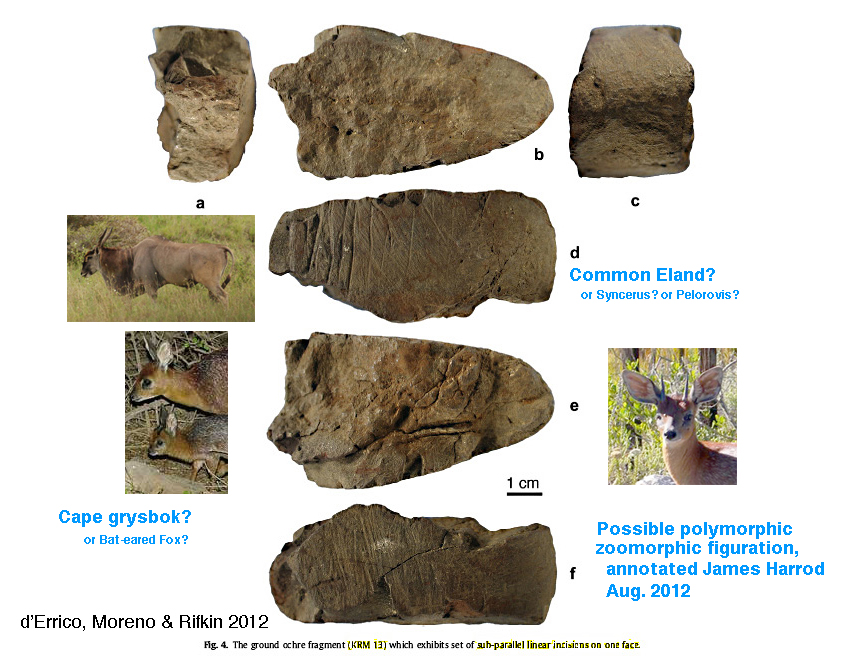
In my July 15 2009 blog I speculated on how several engraved ochre pieces from Blombos Cave Middle Stone Age (Henshilwood, d'Errico and Watts 2009) appeared, at least to me, as having more than just a bunch of scrape marks. Rather they appeared to have overall shapes and then intentional markings that were zoomorphic, with closest zoomorphic matches being 'lion', 'elephant' and 'wildebeest'. Now I'd like to point out another zoomorph in red ochre from a different MSA site, Klasies River Cave 1 (d'Errico, Moreno and Rifkin 2012). The authors found one piece of red ochre unlike the dozen or more other ochre fragments that showed grinding and use-wear. Their analysis showed the ochre material was selected for being distinctive compared to the other fragments, confirmed the incised lines are anthropogenic; and observed that the piece's surface was first scraped or rubbed and then a "robust rounded lithic point was used to incise a sequence of a dozen or so straight and curvilinear sub-parallel lines on the object" (948). After their examination the authors conclude that "the purpose of marking this object remains uncertain" and they offer no hypotheses (949).
Their 'uncertainty' appears to me to reflect the authors' failure to consider that the artifact might be a 'figure stone', which at least in France, since the time the archaeological establishment condemned Boucher de Perthes one of the founders of French archaeology, for identifying 'figure stones', has been a taboo topic for archaeology and prehistorians. For non-French archaeologists it is perhaps not a taboo, but apparently it is a rarity in the Anglo-American world for any archaeologist to venture out of the 'tool-realm', which industrious and highly empirical Anglo-Americans accept as the most (if not only) important thing in the world of 'culture', while they are paranoid when it comes to anything but the most obvious examples of realistic art or the most literal and pseudo-cognitive concepts of spirituality.
In the following image I have annotated d'Errico, Moreno and Rifkin (2012: fig. 4) to indicate faunal matches for possible Klasies zoomorphic figuration on the red ochre engraving piece. I suggest that the use of natural and artificial zoomorphic shapes and method of incising ochre are similar at both Klasies River Mouth and Blombos. That this similarity occurs at two different sites during the mid-MSA I take to be supportive evidence for my interpretation.
2011 February 25, 2011
Its another great day for proponents of the 2 million year long chronology of out-of-Africa. Check out L'Anthropologie Volume 115, Issue 1, January-March 2011, Pages 176-196, a special issue reporting on the 2003-2006 Franco-Chinese joint field season at the site of Longgupo, China. The site is dated 1.9 Mya. The lithics article (Boëda & Hou) gives a brilliant detailed analysis of 854 artifacts revealing how the artisans used multi-stage, multi-option knapping operations, which is unlike contemporaneous populations in Africa.
- "To understand the technological chain-of-operations Boëda has to come up with a new archeological concept, the 'matrix'."To avoid placing these tools in a restrictive, semantically meaningless, class, we prefer the concept of matrix to the term worked cobble. A matrix is a structured arrangement of a series of technological traits, in a form as close as possible to that of the future tool." (Boëda & Hou 2011, Lithics abstract).
This concept parallels closely the concept I discovered in the Koobi Fora 'core-with-inner-rhomboid' to grasp the 'Meme' of the Oldowan, which I termed 20 years ago, 'the core seed essence'.
In the concluding article (Boëda & Hou 2011, Synthesis abstract) they state:
- "If the hominids are of African origin, as data support, we can hypothesize that the date of the first population diffusion must be moved back to 2.5–2.6 mya, and that the first populations in central China were oriented toward new technological options, which are only found in Africa much later. In the present state of research, it appears that we should abandon our old paradigms, which have over time become “truths”, because instead of a unifying view–monolithic–of these periods, we advocate recognition of the existence of spatial and temporal cultural otherness."
This puts all sorts of short chronology theories of when hominids migrated out-of-Africa in the horns of dilemma. Either hominid evolution is multi-regional from the beginning--the earliest fossil evidence is Australopithecus garhi (Bouri, 2.5 Mya) and Homo rudolfensis/Homo habilis (Omo Shungura, 2.3 Mya; Upper Kada Hadar AL666-1, >2.3 Mya)--or the earliest hominids had no problem migrating out-of-Africa all the way to China. If they had no problem, why would it have been any more of a problem for H. erectus/ergaster or H. sapiens sapiens to diffuse from Africa most any time they desired? This then is thus another refutation of the sapiens sapiens short chronology (60 kya out-of-Africa). Sapiens sapiens could have diffused any time after the fossil evidence for Omo Kibish 195,000 years ago, and as we have argued, optimally 120,000 years ago, carrying a Middle Paleolithic tool-and-art kit.
I am delighted to see that during the last few months within academic archeology old dogmas are collapsing for every major time period in human evolution.
February 23, 2011
The anthropologist John J. Shea has published an excellent article in the March American Scientist. http://www.americanscientist.org/issues/feature/2011/2/refuting-a-myth-about-human-origins/1
Shea argues that stone tools that appear associated with Omo Kibish 195,000 years ago are no more 'archaic' or 'primitive' than those that occur later and if the term 'behavioral modernity' means anything it applies to all Homo sapiens sapiens from Omo Kibish on.
This supports our argument that the primary migration of Homo sapiens sapiens out of Africa occurred around 120,000 years ago AND CARRYING A MIDDLE PALEOLITHIC ART-AND-TOOL KIT and spread across the so-called Southern Route or routes in that general area to Australia by around 60,000 years ago.
It is one more argument against the Recent-out-of-Africa model (ROM) of Richard Klein and others that the first diffusion of 'behaviorally modern' sapiens sapiens out of Africa began around 50,000 years ago with an Upper Paleolithic/Later Stone Age art-and-tool kit.
(Of course, we at OriginsNet have further argued that ROM 1s an obsolete paradigm and that behaviors considered ‘modern’ (such as symbolic behavior, bone tools, seafaring, language, distance exchange of goods, aquatic resource foraging) in fact appear in the archeological record throughout the 2 million year archaeological record of Homo hablis, Homo erectus, ‘archaic’ Homo sapiens (Homo helmei, Neanderthals, etc.) and Homo sapiens sapiens
January 31, 2011 This month saw publication in the journal Science of two articles that fully support our position that the major wave of migration out-of-Africa of Homo sapiens sapiens was one carrying a Middle Paleolithic tool-and-art kit and it occurred during the last Interglacial, OIS 5e 120,000 years ago give or take 10,000 years. With these two articles I suggest that we consider the so-called ROM (Recent Out-of-Africa Model -- H. s. s. leave Africa with an Upper Paleolithic tool-and-art kit 45-60,000 years ago) proven false.
In the January 7 issue of Science, the science writer, Michael Balter, in an article 'Was North Africa the Launch Pad for Modern Human Migrations?' reviews new datings, discoveries of symbolic behavior and new hominid fossils for the North African Aterian culture which show its affinities to Skhul and Qafzeh.
If this review were not convincing enough, the January 28 issue of Science published Armitage, Jasim et al 'The Southern Route "out of Africa": Evidence for an Early Expansion of Modern Humans into Arabia'. This study reports finding Middle Paleolithic tools at Jebel Faya, Sharjah, U.A.E., dated by OSL -- 3 dates at 95,000, 123,000 and 127,000 years ago. Called 'Assemblage C', the tools are characterized by small handaxes and foliates. The tool assemblage has affinities to NE Africa, but none to Neanderthals. Further, stone assemblages above this level, Assemblage B, dating between 90 and 40,000 years ago, has no parallels in Africa; and the same goes for Assemblage A, dated 39-40,000 years ago. This indicates at least at this site that the Late Middle Paleolithic and Early Upper Paleolithic industries are local developments; they didn't come out-of-Africa as the ROM model hypothesizes.
I note that Jebel Faya Assemblage C can be compared to the Middle Paleolithic with handaxes assemblage at Abdur Reef, Buri Peninsula, Eritrea, dated by TIMS U-series to 125±7 kya.
With respect to the January 7 Balter article it suggests that the Aterian did not make it into the Levant. This view is incorrect. On one of Emmanuel Anati's expeditions to Har Karkom, central Negev, Israel, with its hundreds of hutfloors in a massive hammada of flint, there are definitely both Aterian sites and Middle Paleolithic with handaxe sites. I have documented this with an extensive series of images right here on OriginsNet http://www.originsnet.org/gallerymp.html
This even includes our illustration of the Aterian hutfloor and the artifacts within it, including a series of stone sculptures as well as the remarkable triangular-'female' sculptures from MP-with-handaxe sites.Now that the Interglacial migration date seems acceptable to a science writer like Balter, we may be assured that the bandwagon is moving on, the old ROM paradigm is over, and we welcome the short chronology proponents, including Richard Klein, Paul Mellars, and Steven Mithen to jump on board.
"First people deny a thing, then they belittle it, then they say it was known all along!" Von Humboldt
March 26, 2010
Re: March 24 Nature article, 'The complete mitochondrial DNA genome of an unknown hominin from southern Siberia,' Krause, Fu et al, http://www.nature.com/nature/journal/vaop/ncurrent/index.html. The analyzed bone comes from Denisova Cave, Altai, Siberia, from Layer 11.2, dating roughly 35-50 ka, a layer having tools of the Siberian Initial Upper Paleolithic (IUP), with a transitional mix of MP and UP types of tools.
Point #1. In our perspective, a most useful inference in this study is that if the mtDNA dating of the 'common ancestor' is accurate, then it supports the view that a major out-of-Africa movement occurred with Middle Acheulian Homo erectus, beginning around 1 MYA to 600 ka (the handaxe/cleaver industries).
As noted in the previous post, this is precisely the position I have advocated for in 'Knocking Down the Straw Man Once Again'. There are three major periods of cultural globalization in the Paleolithic: Classic Oldowan (Homo habils/rudolfensis) Middle Acheulian (Homo erectus) and mid-Middle Paleolithic (Homo sapiens sapiens).
The archaeological evidence shows a clear West to East gradient from Africa into China for the Middle Acheulian handaxe/cleaver industries. In contrast, Early Acheulian and Later Acheulian technological innovations do not appear to to reach East Asia. Instead these areas appear to evolve their own comparable, and in some ways more advanced, tool industries, during the time periods either side of the Middle Acheulian. So I am happy to see that Krause et al have shown via mtDNA analysis that a major human subclade apparently dispersed and subsequently evolved on its own from that 1 MYA out-of-Africa migration.
Point #2. It is easy to take issue with the authors' Recent-Out-of-Africa hypothesis (50 ka). The very sites in Siberia/Altai mentioned in the article argue against such a short chronology. One of the earliest IUP (EUP) sites is Baigara, Irtysh, Western Siberia [Kuzmin et al, 2009, Journal of Human Evolution 57:91-95]. See our online database for Central Asia/Siberia http://www.originsnet.org/publications.html. At this site they found a 'most probably' Homo sapiens sapiens talus bone, dated 40-48 ka, which THEY COMPARED TO SKHUL IV! This means if we accept that JHE study that, as I have argued all along, MP Skhul-like H.s.s. left SW Asia circa 125 ka (OIS5e), and they or their genes arrived in Altai, with MP technology, not IUP, at for example Kara Bom, ESR 62,200 ka. At that site an MP technology also included "subprismatic blades, crested blades and bladelets"; in other words, it was already by 62 ka innovating on the way to UP. At 43 ka Kara-Bom's technology (alluded to by the authors) -- is described by its excavators as 'Bohunician', or East European IUP. At Mamontovaya Kurya, Komi, near the Arctic Sea, IUP arrives 35,000 ka, with inscribed mammoth tusks. As Marcel Otte and others -- IMHO -- have convincingly argued, the next technological innovation, 'Proto-Aurignacian' (38-32 ka), which appears at Ust'-Karakol, Altai at 35 ka, is either westernmost, or perhaps the origin area, of the Aurignacian appears to be Iran, Uzbekistan, or Afghanistan. And as we see at Kara Bom 62 ka, Middle Paleolithic Skhul-like hominins are already innovating towards that Aurignacian style. In no way does it come 'out-of-Africa' 50 or 40 ka, as argued by Paul Mellars et al, from their myopic Eurocentric perspective. As I have suggested, based on the available archaeology, so-called 'Upper Paleolithic/Later Stone Age' tool industries appear to show multiregional innovation building on the globalized Homo sapiens sapiens mid-Middle Paleolithic art-and-toolkit.
Altai Siberia provides more and more evidence for supporting this position.
January 17, 2010
I've posted a short paper, 'Knocking Down the Straw Man Once Again'. It summarizes my Mother Tongue review of the waves of technological innovation out of Africa or multiregional over last 2 million years, with special focus on the Middle Paleolithic. I posted a new database table for sites in Central Asia/Siberia and updated my East Asia database table with new research. Basically, this paper shows how the short chronology model for 'recent out-of-Africa' (ROM) 50 to 80,000 years ago fails to fit what we know about archaeology from Africa to Australia. People had to leave earlier, likely during the last interglacial, 125,000 years ago, and did so carrying a Middle Paleolithic technology. To my mind its the only model that makes sense. This is the emergent new paradigm.
Of course, once the ROM model falls apart, a whole new series of questions arise. Did people migrate across a 'Southern Route' or did only genes flow and not the people? Did Middle Paleolithic time period technologies of early Homo sapiens sapiens across the 'Southern Route' spread West to East or where there multiregional innovations? Its all open for new questions now.
July 15 2009
The latest issue of Journal of Human Evolution contains an article describing and analyzing 13 fragments of incised ochre from Blombos Cave, South Africa, from Middle Stone Age levels, dating between 73,000 and 100,000 years ago [Christopher S. Henshilwood, Francesco d’Errico, Ian Watts (July 2009). Engraved ochres from the Middle Stone Age levels at Blombos Cave, South Africa. Journal of Human Evolution 57(1): 27-47]. "These finds, taken together with other engraved objects reported from other southern African sites, suggest that symbolic intent and tradition were present in this region at an earlier date than previously thought." They argue that the evidence indicates that many of the striations are intentional engravings inconsistent with power production. Patterns of markings include: sets of parallel lines; fan-shape; cross-hatch/lattice; (previously published) row of X's framed in triple-parallel-lines; right-angle superimposed crossing lines; and 'dendritic' or convergent-lines. M3-9 appears to me to represent a verticle series of nested/overlapping chevrons. This study is a major breakthrough and the dating and descriptions of the artifacts and incisions is meticulous.
For me this study is especially important as it shows that there are parallels to the 30,000 BP UP European geometric signs, for which I have proposed a decoding as ideograms, already in use 70-100,000 years ago, including 'X's, 'tri-line', 'chevron', 'Y' and a variety of arrangements of repeated 'stroke' mark motifs. The article describes a 'dendritic' motif, constituted by a fan-like set of convergent lines, which if taken as a 'convergent-line' motif, can be considered a survival from Early Paleolithic 'convergent/divergent lines' and 'fan' motifs.
The authors infer that the Blombos Cave engravings "may fall within two fields of abstraction; first, that described as non-representational or non-objective as the designs do not derive from recognizable subjects and second, they are abstract patterns that 'reframe nature for expressive effect' (Ettinger, 2005: 211). The first type of abstraction is difficult to identify archaeologically. The second can be demonstrated if the subject of the motifs is identified (d'Errico 1991). In the case of the Blombos engravingts, none of these can be identified as clearly representing elements of the natural world" (45).
I will now show a way in which this inference--'no representations of natural things in the world' can be falsified. I admit that my suggestions for figuration of (a) the shapes of the ochre pieces and (b) at least one metaphorical overlap--the marking termed 'dendritic' and what can be taken as 'skin folds' of a zoomorphic representation--are at this point hypothetical. However, unless archaeologists come up with a justifiable procedure for determining whether a figurative 'likeness' is pure projection or 'intentional' I would suggest that my hypothesis is at least as valid as their conclusion.
Below I present three interpretations of Blombos Middle Paleolithic artifacts as sculptural representations. In one of these, I point out a possible representation of 'lion-head' and associated 'tri-line' geometric sign motif. If you scroll down to a prior blog on the Pavlov VI 'lion-head' you will find that that 'lion-head' also has a geometric sign inscribed on it, which also appears to be a 'tri-line'! If so, that's a long and widespread semiotic tradition.
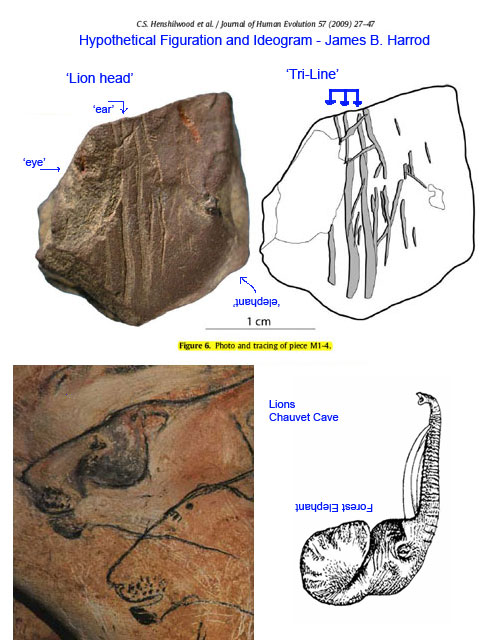
To my eye the clearest figuration on this piece is the possible 'lion-head'; if you rotate it 180 degrees there is a 2nd possible figuration, admittedly more vague, of a forest elephant. If so, this is a depiction, at least in part, of their predator/prey relationship. I do not wager the semiotic denotation of the 'tri-line' and associated marks since the current examples of MSA markings is so limited; I would not go so far as to suggest a denotation similar to that which I have proposed for the European Upper Paleolithic ideogram-system.
In any event, you might compare the full possibly iconographic array to that one the figurine from Pavlov VI: 'lion-head + tri-line + (more vague) proboscid'. Don't be so quick to call it my pareidolia; as a scientist you would be required to refute the imagery with some sort of evidence against it.
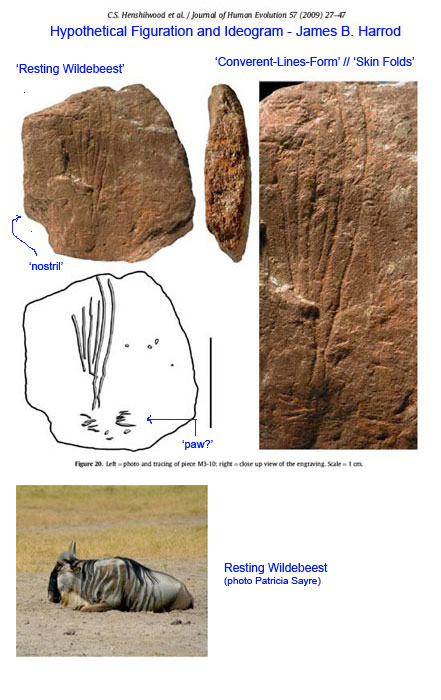
Next, I suggest 'resting wildebeest', and here the 'dentritic' or 'convergent-lines-form' would be placed so as to also represent 'the folded neck skin' of the wildebeest, as in the photo from nature. If it intentionally represents both the pure meaning of the geometric sign and the natural animals skin, then we would have a very interesting metaphor. Perhaps someday someone will find a way to decipher the metaphor.
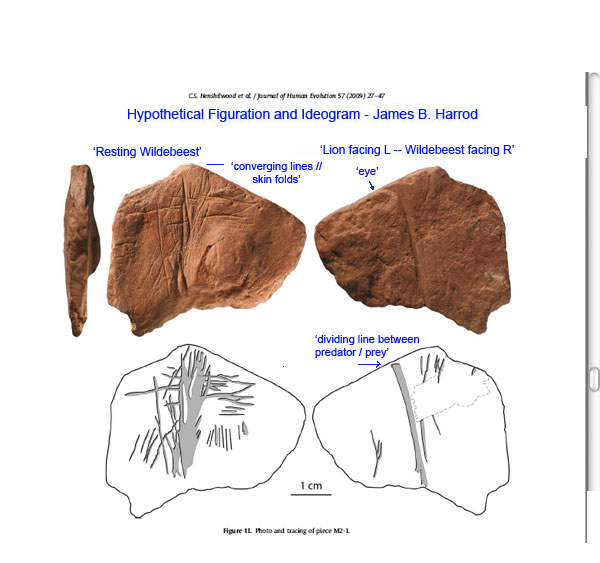
Now, just for fun, in the next artifact, it appears the engravor has made a polymorphic sculpture combining both the lion and wildebeest themes in one piece of red ochre. The structure of a polymorph, using the R - L opposed sides of the object for opposed semantic themes, sometimes employing a rotation of the stone itself, is already evident in Early Paleolithic palaeoart sculptures, and the lion/prey theme is not uncommon.
These 'speculations' are presented with the intention of raising certain questions, opening our minds to wonder and wander beyond the latest dogmas.
July 12, 2009
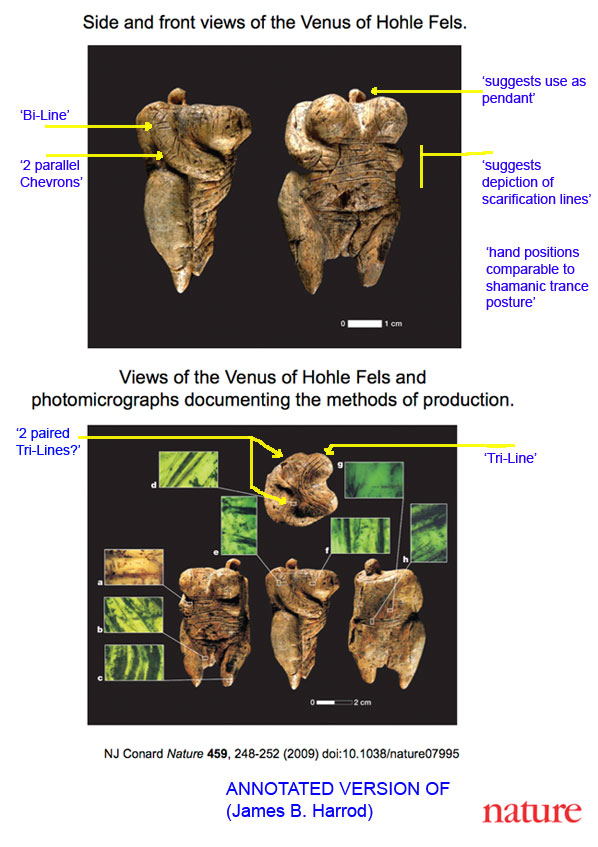
The 14 May 2009 issue of Nature [http://www.nature.com/nature/journal/v459/n7244/full/nature07995.html see also http://en.wikipedia.org/wiki/Venus_of_Hohle_Fels] published Nicholas Conard's remarkable discovery of an Aurignacian female figurine dated to 'at least 35,000 years ago.' The discovery itself, the datings and the microscopic analysis indicating intentional markings on the figurine is a valuable contribution to documenting Upper Paleolithic female figurines. Regrettably, the author's and Paul Mellars' accompanying comments infering the figurine represented something 'almost pornographic', 'possibly girl's toy' or 'object of a fertility cult' would appear to be fantasy projections of male archaeologists steeped in contemporary society's flood of pornographic, abusive objectifications of the female other. The Nature video of the figurine, without embarrassment, is titled: "Prehistoric Pin-up" and similar insulting language then reappeared in media across the globe, including London Times, New York Times and Los Angeles Times. The video minus its Rubert-Murdock-style title is actually worth viewing:http://www.nature.com/nature/videoarchive/prehistoricpinup/
From my point of view the importance of this find is, as I describe in the statement below, that it displays a remarkable set of Upper Paleolithic ideograms, especially, 'bi-lines' and 'tri-lines' which (a) provide support for my proposed decoding of the Upper Paleolithic European ideogram system (protolanguage) and (b) indicate that the figurine is a ritual artifact to be associated with one of the Upper Paleolithic female spiritual transformation processes, namely the transformation which might be title: The Double Goddess, whose ideograms signify 'bifurcate/double and flow'. It is the same transformation which some other so-called 'Venus' figurines express and, of course, it doesn't represent the UP female transformation that actually has its survival in the ancient Greco-Mediterranean cult of Aphrodite; that transformation would be indicated by ideograms, such as circle or triangle plus meander or chevron, signifying 'center and flow'. (Other so-called 'Venus' figurines from Gönnersdorf, Germany, represent a third transformation, the Self-Seeding Goddess.)
So, in gratitude and honor for Conard's discovery I here present my draft 'Communication Arising' that was submitted to Nature and subsequently rejected by the Editor.
An OriginsNet ‘Communication Arising’
Hohle Fels Figurine: A Semiotic Perspective
Nicholas Conard’s report1 of the discovery of a female figurine from Hohle Fels is remarkable for its early Aurignacian dating, but the author’s speculation that the figurine is an “expression of fertility” and Paul Mellars’ comments2 interpreting it as “bordering on the pornographic” or “girls’ toys” appear to be contradicted by the markings on the figurine itself. They have failed to take into account extensive research on the decoding of geometric signs of the European Upper Palaeolithic and the subsequent amplification of these signs into a sophisticated iconography and script during the Danube Mesolithic and Neolithic3,4.
From a semiotic perspective these markings represent typical geometric signs of European Upper Palaeolithic iconography5. The markings across the top of the breasts appear to consist of three parallel lines. This appears to be a typical ‘tri-line’ ideogram, which as, I have proposed, denotes ‘to flow, flow in three worlds’. Two groups of three short lines incised over each shoulder appear to be two more ‘tri-lines’. On the figurine’s right upper arm are two short strokes, a ‘bi-line’, which signifies ‘bifurcate, double’. Below it are two parallel ‘chevrons’, which would signify ‘to flow, flow through a channel’. The syntactic pairing of ‘bifurcate’ and ‘flow’ signs represents one of the major European Upper Palaeolithic female spiritual transformation processes, namely, the Double Goddess6,8.
Similar geometric signs occur on female figurines in the Danube Neolithic4 and these figurines appear to represent a variant of the Upper Palaeolithic Double Goddess. The multiple horizontal lines on the figurine’s abdomen may represent a skirt but may also represent scarification marks. Comparison of European Neolithic figurine markings to African Luba scarification practices, which have associated female figurines representing ancestor beings7 suggests that the user of the Hohle Fels figurine most likely belonged to such a matrilineal society and that the figurine played a role in female initiation or empowerment ritual and symbolized the flow of power and prerogative down through the female lineage.
If this figurine is indeed engraved with such stereotypical geometric signs, the opinions of Mellars and Conard with respect to function and meaning are not supported and the semiotic theory I first proposed over twenty years ago gains strong confirming evidence. What seems most remarkable about this figurine is its degree of semiotic complexity, which I would not have expected until the Magdalenian 20,000 years later.
James B. Harrod
Center for Research on the Origins of Art and Religion
- Conard, N. J. Nature 459, 248-252 (2009).
- Mellars, P. Nature 459, 176-177 (2009).
- Marler, J. (ed.) The Danube Script: Neo-Eneolithic Writing in Southeastern Europe (Institute of Archeomythology, Sebastopol, CA, 2008.
- Gimbutas, M. The Language of the Goddess (Harper & Row, 1989).
- Harrod, J. B. Highlights of the decipherment of Upper Paleolithic (European): A protolanguage of the human spirit. Proc. 1994 International Rock Art Congress, Rock Art-World Heritage, 23-32 (American Rock Art Research Association, 2006).
- Harrod, J. B. The Upper Paleolithic ‘Double Goddess’: ‘Venus’ figurines as sacred female transformation processes in the light of a decipherment of European Upper Paleolithic language. In From the Realm of the Ancestors: An Anthology in Honor of Marija Gimbutas, ed. Joan Marler, 481-497 (Knowledge, Ideas & Trends, Manchester, CT, 1997).
- Haarmann, H. Cultural symbolism on living skin and clay: The female body as mnemonic landscape. Journal of Archaeomythology 5 (Winter 2009), 29-40 http://www.archaeomythology.org
- Harrod, J. B. European Upper Paleolithic Thematic Semantics and the Double Goddess of Grimaldi. Acts of the Valcamonica Symposium 1987: Prehistoric and Primitive Art (Centro Camuno di Studi Preistorici, Capo di Ponte, Italy, 1987).
And here's my reanalysis of the figurine's markings presented in the Nature article:
July 08, 2009
Discussion.
Pavlov VI, Czech Republic, Gravettian, excavated 2007, Jiri Svoboda, dated 31,000 BP, reports a 4 foot wide roasting pit in a circle of smaller pits for boiling mammoth, with heating stones. They found remains of a female mammoth and one mammoth calf, and arctic fox, wolverine, bear, hare and a few horse and reindeer bones as well as stone tools. They also report finding multiple decorated shells with cutmarks, red and black coloration, perforated, decorated pebbles, ceramic pieces and fragments of fired clay. One of the latter appears to be a 'lion head' modeled in wet clay and then fired, which Svodboda hypothesizes may be 'sympathetic magic' [http://dsc.discovery.com/news/2009/06/03/prehistoric-bbq.html], [Svoboda J, Králik M et al. 2009. Antiquity 83,320: 282-295]
OriginsNet circulated a photo of the 'lion head' and the net result, I suggest, is that this sculpture is most likely a polymorphic sculpture, which can be compared to polymorphs from Middle and Early Paleolithic sites. In the attached I have arranged a collage to suggest that the 'lion' may be identified as either a 'lion with open mouth' (comparison to lions of Chauvet) or 'homotherium', with its 'sabertooth' depicted by a flake removal. Jan van Es discovered that by rotating the image the artist has also depicted a 'mammoth'. Thus, the sculpture depicts the predator/prey relationship. I have attached an Early Paleolithic polymorphic sculpture discovered by Richard Wilson at his Hertfordshire site that apparently depicts the same theme.
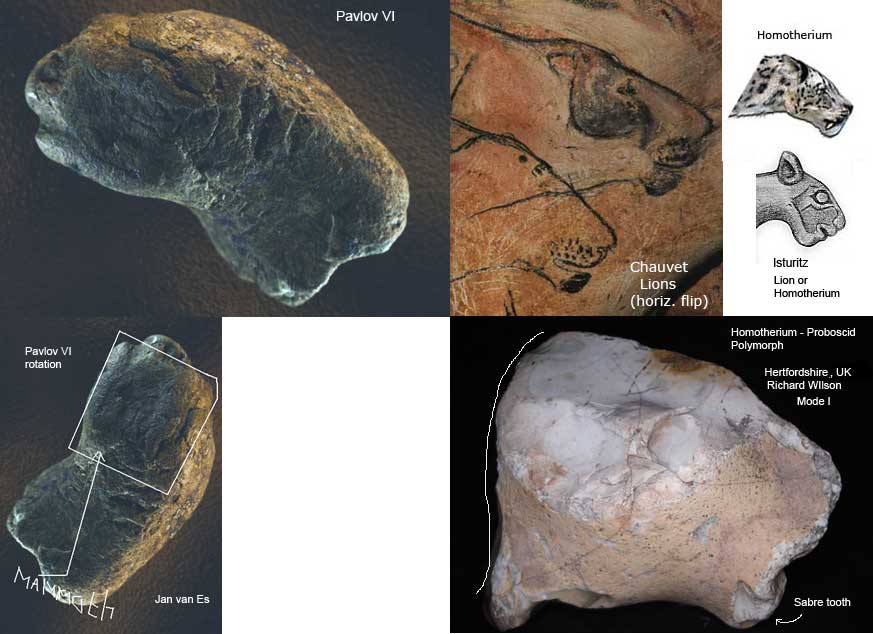
If so this tradition may extend for 400,000 years or more. Jan van Es also suggests the Pavlov VI sculpture may have one or two additional figurations. There seems to be some sort of zoomorph directly opposite the 'homotherium' but I find it indeterminate--I await a good interpretation of that section of the sculpture.
2008 January 18, 2008
Announcement. I've posted a gallery for Koonalda Cave, Australia, to indicate the rich array of art dating between 16,000 to 27,000 years ago at this site. These dates are contemporaneous with European Ice Age cave art of the Gravettian and Solutrian, and points to much older traditions of palaeoart. Koonalda Cave art has multiple petroglyph motifs (digital fluting, lattices, fans, concentric circles), stelae and zoomorphic/anthropomorphic standing stone sculptures. Koonalda was a site for both 'flint' mining and religious rituals.
I placed the gallery in the Middle Paleolithic section of OriginsNet because Australian stone tools of the time continue a Middle Paleolithic technology and because of the remarkable similarities between Koonalda and Har Karkom -- including flint quarrying at each site and stelae and zoomorphic/anthropomorphic standing stone sculptures. This suggests the existence of a shared Middle Paleolithic artistic and spiritual tradition across the Southern Route from Africa to Australia.
January 5, 2008
Happy New Year!
How about some palaeoart sculptures at the Calico site? I happened to be looking at the official Calico website, calicodig.org, and think I can spot four zoomorphs.
Today I've posted a Calico webgallery of images, drawing on the images and descriptions from calicodig.org. I propose identification of four sculptures: one bison, two mammoths, and a horse. The bison is the most identifiable; the others I think more tentative.
Calico is now dated by both OSL and U-Series, making it one of the better dated sites in North America. The two dates suggest the primary occupation occurred in the Sangamon/Eemian OIS 5, with earlier occupations. Bison, mammoth and horse are known fauna during this period, and a mammoth bone was excavated at the site.
Contrary to those would seek to discredit the site as only 'nature-facts' (even Wikipedia suggests this), I have presented text giving the contrary position, which to me is the most valid interpretation. I mention the discovery of an apparent hearth in the early excavation report, one of many facts ignored by the 'Clovis police'. To me the stone assemblage presented at the calicodig.org website appears to reflect not-atypical flake and blade technologies of Final Acheulian Period/Early Middle Paleolithic technology of Eurasia. The gallery images include some of these tools.
Associates of OriginsNet have sent in confirmatory and alternative figural interpretations of the four zoomorphic pieces, and I will post these in a revised gallery soon.
2007 August 23, 2007
If confirmed and supported by additional studies, the discovery accounced today (see abstract below) will have major repercussions for the dating of the stages of human evolution.
If accepted by geneticists, it would appear to push their timescale, which is based on best hypothesis for dating of split of hominids from apes, back from 8 MYA to 11 MYA or roughly 40%.
Such a 40% redating for the genetic emergence of Homo habils, erectus, archaic sapiens and sapiens sapiens would result in DNA-dating more in line with the palaeoart and stone sculpture evidence for 'earlier and longer chonology' that we have presented on OriginsNet.
Here's the abstract.
A new species of great ape from the late Miocene epoch in Ethiopia
Nature 448, 921-924 (23 August 2007)
Gen Suwa, Reiko T. Kono, Shigehiro Katoh, Berhane Asfaw & Yonas Beyene
"Most genomic-based studies suggest a late divergence date—5–6 Myr ago and 6–8 Myr ago for the human–chimp and human–gorilla splits, respectively10, 11, 12, 13, 14—and some palaeontological and molecular analyses hypothesize a Eurasian origin of the African ape and hominid clade15, 16. We report here the discovery and recognition of a new species of great ape, Chororapithecus abyssinicus, from the 10–10.5-Myr-old deposits of the Chorora Formation at the southern margin of the Afar rift. To the best of our knowledge, these are the first fossils of a large-bodied Miocene ape from the African continent north of Kenya." … "The combined evidence suggests that Chororapithecus may be a basal member of the gorilla clade, and that the latter exhibited some amount of adaptive and phyletic diversity at around 10–11 Myr ago."Full abstract at
http://www.nature.com/nature/journal/v448/n7156/abs/nature06113.html
July 31, 2007
New Discovery of UP Rock Art in 'European style', Qurta, Egypt, 15,000 BP.
This Antiquity article announces a major re-discovery of rock art petroglyphs at Quarta, Egypt on the Upper Nile. They are done in a style said to be similar to that of Magdalenian rock art in Europe. The are dated to 15-16,000 BP based on comparison of depicted fauna with similar faunal remains at nearby Upper Paleolithic sites of that date.
Here is the Antiquity article: http://antiquity.ac.uk/ProjGall/huyge/index.html
The themes are interesting. Primarily aurochs and birds. There are several female figures. I note that they are in the style of Gönnersdorf, Lalinde and Fontales. Marija Gimbutas interpreted figures in this style as representations of a Bird Goddess, which continues from UP to the Neolithic. She noticed that sometimes the large buttocks has an egg depicted in it. There is at least one European image, I think its from Fontales, where the egg is depicted in the buttocks. Marija put this image in her Language of the Goddess. Marshack has also done a very good microscopic analysis of the way these images were constructed.
The dating by comparison of faunal remains to local UP site seems plausible.
The fact that this art at this date is in Egypt will force a major rethinking about Upper Paleolithic art.
Fiedorczuk et al in the March 2007 Antiquities Journal publish a find of 'strangulated blades' interpreted as female figurines, from the Magdalenian site of Wilczyce, Poland. This is said to be the first discovery of female figurines made in flint as opposed to the well-known examples in bone and ivory.
http://archaeology.about.com/od/upperpaleolithic/a/0307_venusfig.htm.
http://archaeology.about.com/od/artandartifacts/ig/Wilczyce-Figurines/index.htm.
The journal Archaeological Berichten (Netherlands) and associates have published many examples of female figurines made on blades, 'strangulated' or otherwise, for example see A. Lefebvre-Bara, The pre-historic stone-industries from the marine deposits of Coquelles (Calais, France) in Archaeological Berichten No. 19 (1989):134-186. The Coquellian, recognized by Breuil, Pielenz, Baudet and others from Baltic to Calais, appears to be a Clactonian-with-blades that evolved during one of the interglacials (Holsteinian to Eemian or Later Acheulian period to Middle Paleolithic). Archaeological Berichten No. 20 (1990):104 illustrates Upper Paleolithic blades shaped into female and polymorphic figurines from multiple UP sites, including de Baanen (Federmesser). Clearly Upper Paleolithic female figurines belong to a tradition well-over 100,000 years old.
Fiedorczuk et al interpret the figurines as 'stylized voluptuous female outlines' probably made by young men, i.e., as pornographic fantasy. Besides being sexist, this view is not falsiable and hence not science, but simply a male projection fantasy.
I have presented a detailed scientific analysis of these female figurines based on my deciphering of Magdalenian geometric signs. Upper Paleolithic (European) figurines can be decoded into a set of six basic female and six male spiritual transformations. The Gönnersdorf type should be designated 'The Self-Seeding Goddess' and contrasted by the falsely-labeled 'Venus' type , which is actually a form of the 'Double Goddess'.
Fiedorczuk et al should become aware that the classic type site of the Self-Seeding Goddess at Gönnersdorf occurs in a site context of religious ritual (two huts connected by the pathway of engraved broken plaquettes, with the figurines found in pits protected by fox pelts, in groups of 3, and so on). Gönnersdorf along with El Juyo, Cantabria represent the two best examples of religious ritual sites in the Magdalenian setting aside the parietal rock art.
2006 Major African Palaeoart Discovery:
A team of archaeologists led by Drs. Sheila Coulson and Nick Walker, University of Oslo, have discovered "evidence of humankind's oldest ritual" at Rhino Cave in the remote Tsodilo Hills of Botswana. Finds include: cupules and abraded grooves on a rock surface that is interpreted as having shape of a python, a creator being in San mythology, and in the excavation just below it beautifully made Middle Paleolithic points, with those of red color intentionally burnt and destroyed, and also engraving tools that appear to associate to the petroglyphs. By tool comparison the dating would be similar to the nearby site of &Mac173;Gi, which has TL dating at 77,000 years ago.
http://www.hf.uio.no/iakh/for-ansatte/avis/2006/oktober/botsw.html
http://news.nationalgeographic.com/news/2006/12/061222-python-ritual.html
This is an extremely important find that supports the view that there was a common and global artistic/religious symbolism that blossomed from Africa to Australia during the Mid-Middle Paleolithic (associated with early Homo sapiens sapiens).
For European Middle-Paleolithic religious stonework, see Middle Paleolithic
Palaeoart Image Galleries.
Email, September 2006. The identification of 'baboonheads' in proposed Early Paleolithic stone sculptures from NW Europe is questioned on the basis that there is no evidence for primates other than ancestral humans and macaque monkeys in Europe during the Pleistocene. I have done a websearch on this and updated my comment on Pampau artifacts proposed to represent cercopithecids and apes. In brief, we have recently two 'giant baboon' finds in Europe, Theropithecus oswaldi, Cueva Victoria, Spain (ca. 1 MYA) and Theropithecus sp. (?) at Pirro Nord, Italy (ca. 1.3-1.6 MYA).
Email, August 2006, Ursel Benekendorff sends for discussion images of Pampau figurine, ca. 500,000 BP, clearly worked and suggesting it be identified as either bison or musk ox, with flaking possibly to indicate giving birth. Serendipitously, my partner, Patricia Reis, had just returned from a rafting trip on the Sheenjek River, Alaska, Arctic National Wildlife Refuge and brought back photos of a musk ox. We received additional musk ox photos from a trip participant, Peggy Braun, and my vote is that the Pampau figurine is a stunningly good representation of a musk ox.
(Click here for OriginsNet Pampau Musk Ox Gallery, with comparison photos from Alaska musk ox.)
(Click here for Benekendorff Website)
| .... | OriginsNet.org | ......... |